


HOME | TRAILS | THINGS TO DO | FOOD | SHOP | LODGING | FT ATKINSON | LAKE KOSHKONONG
Lake Koshkonong Effigy Mounds Historic Site Give Visitor Glimpse Of Early Wisconsin Life
Article By Lakes Edition Staff
Reading Time:
15 minutes
Last Updated: 02/24/2026
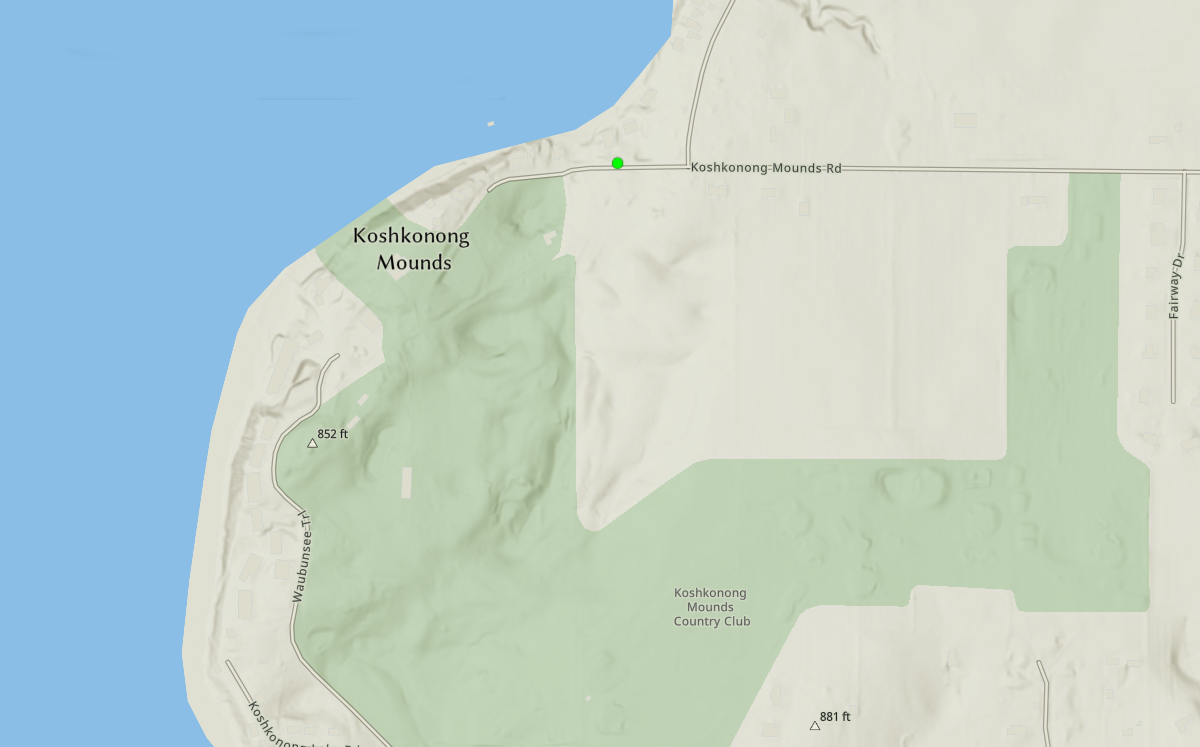
It is a secluded oasis of green tucked away from the busy, four lane, Hwy. 26 heading south to Janesville. A place likely as peaceful and spiritual today as it may have been centuries before the first, Anglo or saxon arrived in the area. Here atop a wooded hillside that slopes down to Lake Koshkonong, ancient descendants of the Ho-Chunk people created sacred ground to honor their dead and praise the spirits of their world. Today, this historic site, the remaining portion of the General Atkinson Group, is nationally recognized as one of the finest examples of effigy mound clusterings in the U.S. to have sacred effigy grounds untouched by western europeans right here in Wisconnsin is something to behold and revere.
A wood framed, sign erected by the Ho-Chunk nation's Department of Heritage Preservation of the entrance of Jefferson County Indian Mounds and Trail Park proclaims this place as "an ancient burial and religious site of the Ho-Chunk People." Listed on both the Wisconsin and National Registries of Historic Places, the park is home to 11 unique effigy mounds believed to be built by a civilization archaelogists refer to as the Late Woodland Indians more than 1,500 years ago.
Between AD 650 and 1200, groups of Native Americans throughout the southern half of Wisconsin and portions of adjacent states
built earthen mounds of various shapes and sizes, including mounds shaped like animals, today called effigy mounds. The 11 mounds preserved here in the Jefferson County Indian Mounds and Trail Park were part of a larger group of 78 mounds and include symmetrical and animal shapes, resembling birds, turtles or lizards, and perhaps spiritual figures. A remnant of an ancient trail is also visible in the park. It is a secluded oasis of green tucked
The people who built effigy mounds hunted and collected food, often returning to the same locations seasonally. They lived in semi-permanent villages, used the bow and arrow, and made and used pottery. Mounds likely served ceremonial, spiritual and practical purposes, perhaps marking territories and designating special gathering places. Mounds often, but not always, contain burials. The Lake Koshkonong area once had 23 effigy mound groups, composed of about 500 individual mounds. Some mounds began as burial sites but were built up over the years to the figurative forms you can see today.
Types of effigy Mounds:
Effigy mounds were also ingeniously constructed clan symbols and figurative representations of spirits of the upper and lower worlds (sky and water/land.) Though mounds can be found in other states, it is the variety of patterns and animal forms, such as groups of birds, that are unique to Wisconsin. Out state is home to more effigy mounds than any other region in the North America. Jefferson County alone may contain more than 1,000, including 500 by the shores of Lake Koshkonong. Mounds area Wisconsin built by the Woodland Period Indians are found in four distinctive types:
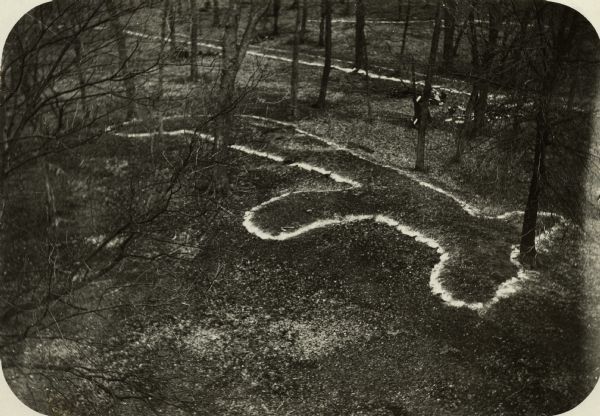
(photo courtesy of the Wisconsin Historical Society)
(1) Conical - Created for burial. Dimensions: 1-3 ft. in height. At least 8' in diameter.
(2) Effigy - Created for burial, clans symbols, spirit representations, and possibly ritual. Shapes such as: Birds, waterfowl, turtles (water, spirit), bears, lizards, panthers (water spirit), deer, mace, dumbell, conceal, war club, tadpole, and single frog mounds. Dimensions: up to 2' to 4' ft in height. Length up to over 624' (wingspan of bird effigy at Mendota State Mental Institution on the north shore of Lake Mendota.
(3) Linear - Created for burial but possibly ritual. Shapes such as: club, or kidney, curved geometric forms. Dimensions: 120 ft. to over 600' ft. in length.
(4) Intaglio Effigy - Excavated forms representing clan symbols, spirits for ritural only? Shapes existed such as those typical of effigy mounds. Supposedly only one of these in the entire world exists: the Panther Intaglio near Fort Atkinson along Riverside Drive.
It is a sad tragedy of our state's history that more than 70 percent of the effigy mounds that once existed in Wisconsin have been destroyed by road construction, agriculture and urban sprawl. To curtail that trend, in 1985 Wisconsin enacted the Burial Mounds Act prohibiting the desecration or removal of effigy mounds. And local historians, and preservation groups partnered with the Ho-Chunk area out and about across the state to restore these mounds to their original condition and svae them for future generations. One such individual who care deeply about the legacy of Wisconsin's early people and culture was Hugh Highsmith (1914-2009) a noted businessman, philanthropist and historian. It is through his work that the mounds at Fort Atkinson are standing today. Through property acquisition around Lake Koshkonong, and even authoring a book, "The Mounds of Lake Koshkonong and Rock River" to get the word out about the mounds.
Interested in learning more about the history of the mound builders or the Ho-Chunk people? Please visit the Ho-Chunk Nation's Department of Heritage Preservation web page or call (715)-284-7181 for more information.
Towns Nearby

Ft. Atkinson
Home to one of the largest suppliers of farm supplies, toys and educational materials in the U.S., the world's only intaglio effigy mound, and of course the venerable Fireside Theater.
Here is more about Fabulous Things To Do In Ft. Atkinson.
HOME | TRAILS | THINGS TO DO | FOOD | SHOP | LODGING | LAKE KOSHKONONG